|
The Mirage
V is a simplified version of the famous Mirage III E
, developed to be put in service in the Israel Air Force. It is basically
a Mirage III E without the radar and Doppler, optimized for ground attack. On 16
February 1968, after competition with
the Northrop F-5 Freedom Fighter (chosen by the Netherlands),
Belgium ordered 106 Mirage V to replace the F-84F Thunderstreak and
RF-84F Thunderflash equipping most of it’s tactical bomber and reconnaissance
squadrons. 63 “BA” single seaters attack aircraft, 27 “BR”
reconnaissance version and 16
“BD”, dual seaters were put in operations. “B” stands for Belgium.
All, except one were build under license by S.A.B.C.A in Belgium. The first
aircraft, a dual seater , was delivered on 28 August 1970 directly from the
Dassault factory in France to n°8 sqn OCU in Bierset AB. After a long and
distinguished career, all remaining aircraft were withdrawn from use in December
of 1994. 42 sqn was the last squadron to operate the type together with n°
8sqn. Some aircraft , some of them retrofitted
with improved avionics , called MIRSIP, were bought by Chili and are
still in use under the name “Elkan”.
The
42 Tactical Reconnaissance Squadron of 2nd Tactical Wing
was the sole reconnaissance squadron of the BAF, operating with Mirages
from Florennes Air Base. The squadron insignia is a devil looking through a
binocular and is a heritage of pre
WW2 recce squadron of Belgium’s Aéronautique Militaire. The squadron was
disbanded in 1994 together with the withdrawal of the Mirage, but the
“Mephisto” can still be seen on reconnaissance pods used on the F-16A of 1
squadron ‘”Stingers” operating from Florennes,
who has taken over the reconnaissance role in BAF.
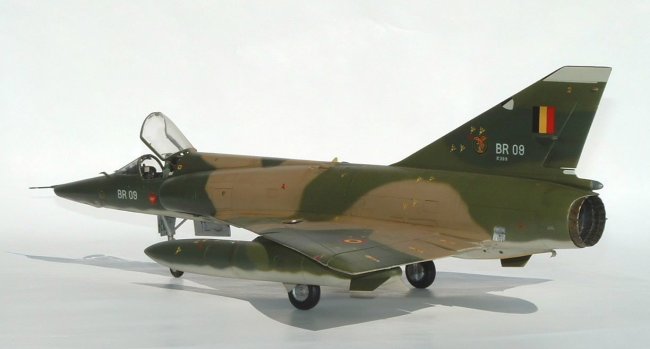
THE MODEL
In
the late seventies, Revell issued a 1/32
scale model of the Mirage III E. Included was a reconnaissance nose for the
Mirage III ER version. The same kit was later issued as a Israeli Mirage V and
in the early nineties was issued again by Revell Germany as Mirage V BR in 42
sqn BAF , 70th anniversary scheme of the devil’s badge.
The
Revell model is peculiar to the late seventies: raised details, spartan cockpit
but , the most important, it captures the elegant lines of the Mirage very well.
Dimensions are mostly correct, nothing to worry about except that the nose at
the front cockpit section is a little bit to narrow, easily corrected by
inserting a plasticard shim.. The model is a very good basis for conversion and
super detailing. Having access to the real aircraft thanks to my childhood
friend Bernard Gillard,
recce pilot, I was able to pinpoint every part of the aircraft needing
modifications to make a decent Belgian version.
I
began with a super detailed cockpit, using flight manual drawings and actual
pictures as reference.
|
-
The cockpit sides and consoles were detailed as was the front instrument
panel which was
completely scratchbuilt using the well known sandwich method: plasticard
back, acetate for instrument glass and front panel with holes drilled at
adequate place and size.
Instruments were bits of decals put on the back. Also, the backside of
the instrument panel was detailed with wiring, as can be seen on the
picture to the far right. |
| Click
on images below to see larger images |
 |
 |
|
| -The
Mirage V was equipped in the Martin Baker BRM 4, a French license build
MB Mk 4. As the model seat was not so convincing , I scratchbuild a new
one using platicard, milliput for the parachute housing and seat pack, leather
harness and Waldron buckles. The
scratchbuilt seat has more than 40 parts and is a model on its own. At a later
stage in their life (around mid-eighties), Belgian Mirages were re-equipped with
a later mark Martin Baker seats, Mk 10. |
| Click
on image below to see larger image |
 |
|
| AIRFRAME
As
said before, the Mirage V is basically a simplified Mirage III E so the Revell Model
is an adeqaute basis, who only needs some refining.
The
next step was correcting and improving the airframe :
|
| Click
on image below to see larger image |
 |
 |
 |
|
NOSE
As
a frequent visitor to 42 squadron, my decision was quickly made. I would make a
BR version.
-
The nose included in the kit needs some modifications to represent a
Belgian version. All cameras windows
were repositioned in clear
plastic.
-
To get the correct profile of nose drop, I enlarged a picture given by
the squadron to correct scale. Note that on a later stage in the career of the
plane , the nose was modified to include a new panoramic camera. My model shows
the early configuration.
-
The pitot tube , called ‘perche Chaffois’ by the French, is made from
a metal paper clip turned to shape.
-
Static pressure sensors in front of windscreen
were made from tube and plasticard
LANDING GEAR
This
was the most difficult part of the project.
-
As the kit pieces were so fragile, I reconstructed the main landing gear
with brass tubing together with plastic bits taken from original model.
-
Nose landing gear needed special attention as the model one is absolutely
not convincing.
-
wheels hub were modified and detailed
-
All wheel wells were reboxed and detailed as per original , with tubing,
wiring etc...
-
Wheel wells doors were detailed with interior framing
| WING TANKS
Belgian
aircraft usually flew with big 1700 liters drop tanks. As these were not
included in the kit ( who provides only 1300 liters tank and 500 liters
supersonic tanks), I had to build them from scratch.
-
½ nose of tank was shaped in a balsa block and I
vacuformed 4 halves. Same for the rear of the tank.
-
I was lucky enough to find a cigar tube of the correct diameter to make
the central part of the tank.
-
Winglets of tank were made in plasticard
|
| Click
on image below to see larger image |
 |
|
EXHAUST
The
Revell model gives a good representation of the ATAR
9C engine of the Mirage. I did not use it but made some modifications to
the exhaust to make it more resembling to the real one. Two rows
of “petals” , one “outer” one “inner” ,were made in aluminum
.Each inner petal was linked to the outer one with plastic stretched sprue.
|
Click on images below to
see larger images |
 |
 |
PAINTING
All
Belgian Mirages were painted with a
so-called SEA camouflage, with no defined pattern as all aircraft have
different schemes, with light
gray undersides till 1980. The wraparound camouflage
was introduced later (It
appeared on Belgian Mirages around mid 1980) and the planes were also later
equipped with the LORAL 3 ECM equipment and chaff & flare dispensers.
I
went into search to find an original aircraft with some “zapping” on it. I
had seen pictures of aircraft featuring some , which had participated to the
NATO Royal Flush competition of 1975. The photo section
of the squadron provided me with a serie of pictures of BR-09 which was
adorned by a lot of “zapping” from other NATO’s squadrons. Especially, the
small yellow feet of Luftwaffe AG 52 “Owl” was
an interesting challenge.
The model was airbrushed with Pactra colors . All markings were “home made.
This
included :
-
Belgian cockades and fin flash
-
The Mephisto badge and AG 52 owl were handpainted on a spare decalsheet
-
all zapping were painted on decal
paper using a “homemade stencil”. A lot of the AG 52 Owl feet were made,
only the best were used. The red paper doll is a zap from French AF 33 Escadre.
-
Serial and registration numbers were taken from spare decals.
The
entire model was varnished with a mix of clear and mat varnish to give it satin
sheen.
|
Click on images below to
see larger images |
 |
 |
CONCLUSION
But
I forgot to you tell something: I build this model in 1980
when resin, photoetching (except
Waldron’s buckles), aftermarket decals (like Belgium’s Daco) didn’t exist.
After 22 years , it still looks as it was finished yesterday except for a little
yellowing of the underside gray..
The Revell
model, although not actual standards , makes a very sound base to represent this
plane in all versions except the IIIC and the two seater
that would need some major surgery. With the “cottage industry” , I
wonder why nobody has never issued a super detailing kit for it. With all those
countries who operated or still operate the type , you bet
it would be a “best seller”.
Should
you want to model a Belgian Mirage
, I recommend “Mirage V” n°11 in the Lock On series of Verlinden
publications who has plenty of details pictures of every variant of Belgian
aircraft.
Robert
|
|