|
Product #09919 (http://www.hlj.com/product/HSG09919)
from HobbyLink
Japan (http://www.hlj.com/scripts/hljlist.cgi?rel=nav&GenreCode=Air
History
In late 1941, Nakajima introduced the Sakae 21, which used a two-speed
supercharger for better altitude performance, and increased power to 840 kW
(1,130 hp). Plans were made to introduce the new engine into the Zero as soon as
possible. The new Sakae was slightly heavier and somewhat longer due to the
larger supercharger, which moved the center of gravity too far forward on the
existing airframe. To correct this, the engine mountings were cut down by 20 cm
(8 in), moving the engine back towards the cockpit. This had the side effect of
reducing the size of the main fuel tank (located to the rear of the engine) from
518 L (137 US gal) to 470 L (120 US gal). The previous type 32 Zero had the
folding wing tips from the type 21 Zero removed creating a shorter wing span.
The wing changes had much greater effects on performance than expected. The
smaller size led to better roll, and their lower drag allowed the diving speed
to be increased to 670 km/h (420 mph). On the downside, maneuverability was
reduced, and range suffered due to both decreased lift and the smaller fuel
tank. Pilots complained about both. The shorter range proved a significant
limitation during the Solomons campaign of 1942. In order to correct the
deficiencies of the Model 32,
a new version with the Model 21's folding wings, new in-wing fuel tanks
and attachments for a 330 L (90 US gal) drop tank under each wing were
introduced. The internal fuel was thereby increased to 570 L (137 US
gal) in this model, regaining all of the lost range. As the airframe was
reverted from the Model 32 and the engine remained the same, this version
received the navy designation Model 22, while Mitsubishi called it the A6M3a.
The new model started production in December, and 560 were eventually produced*.
Click on
images below to see larger images
The Kit-
The A6M3 kit has been released a couple times already by Hasegawa
over the last couple of years. It’s a fairly typical Hasegawa kit that
most of us have come to known with fine recessed panel and crisp rivet
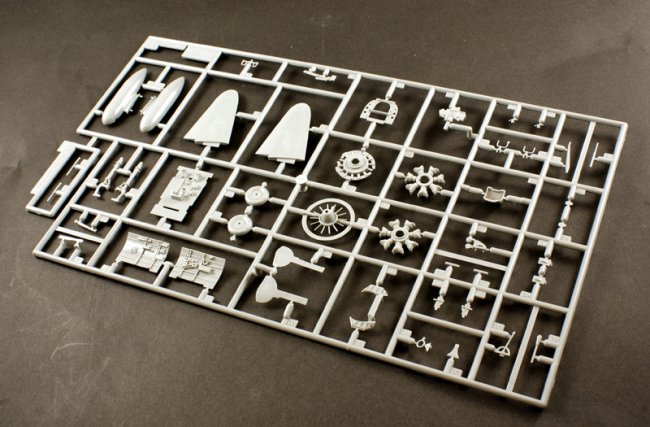
detail. The kit is molded in 698 medium gray and clear parts and bagged in
a single bag. The 13 piece cockpit has been nicely tooled with some
excellent detail in this scale. The seat will require the lighten holes
drilled out and an aftermarket seat harness of your choose will be require
to make that cockpit to pop! Also included is an excellent 5 piece
Nakajima Sakae 21 engine. The cooling fin’s are crisply molded along
with the spark plugs. The dry fit of the parts shows an excellent fit and
hopefully the modeler will not require any filler during the build. A
couple of the parts have a very small amount of flash. But, this is mainly
on the trailing edges of the elevators, a quick pass with a piece of
sandpaper will easily fix. The instruction sheet is the standard Black and
White fold out type that comes with all Hasegawa kits. The build process
is very short in 11 steps. All the assembly points and callouts are very
easy to follow and clear to understand. The painting callouts are in Mr
Color lacquer and GSI Creos Aqueous ranges, but these can be easily
converted to your favorite paint brand.
The print and colour registry on the decal sheet is very crisp.
Decals are nice and thin and appear to be a newer type of decal paper that
Hasegawa has been using lately. These will sit down very nicely with a
small amount of setting and sol solution.
There are 3 aircraft markings supplied in this boxing, two are green
over grey and one all gray.
Type22 Koh, 201^st Naval Flying Group, Lt Shiro Kawai, #2-163, 1943.
Type22 Koh, 201^st Naval Flying Group, #6-171, 1943.
Type22, 202nd Naval Flying Group,
#X2-172.
Overall, the simple construction process and offers plenty of detail even
for the most experienced modeler. This offering of the A6M3 Zero from Hasegawa
is worth having for any WW2 or Japanese collection.
I would like to thank HobbyLink Japan (www.hlj.com
) for providing this review sample.
Dave Johnson
Click on
images below to see larger images
|
|